

 Blogs
Insights, stories, and trends shaping the future of education for schools, teachers, and students.
From Policy to Performance. Are we there yet?

Infakt
25 July 2026 4 min.read
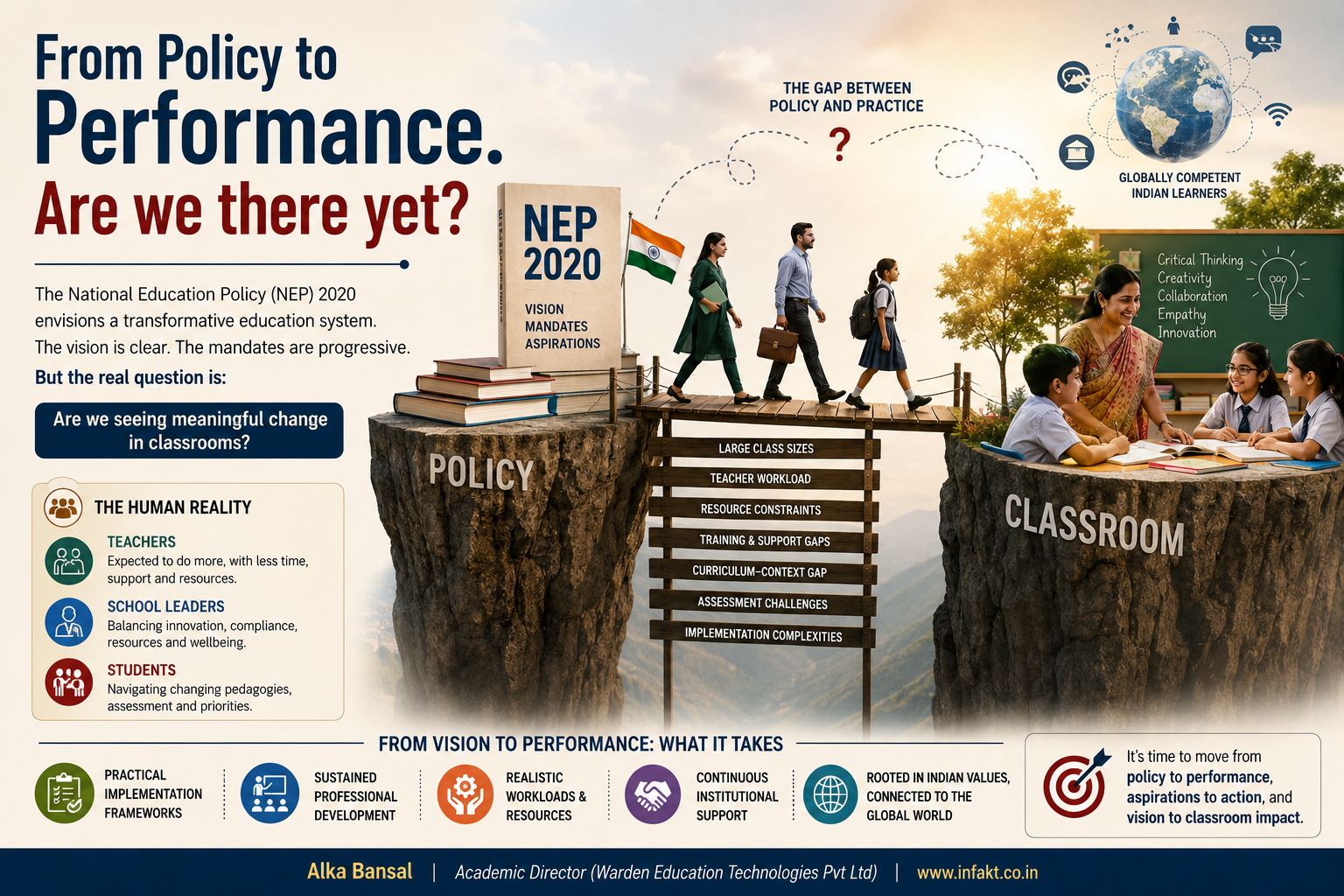
The National Education Policy (NEP) 2020 came with the promise of transforming India’s education system. The vision was to bring Indian education at par with some of the world’s most respected educational systems. On paper, the policy is ambitious, progressive, and comprehensive. Its mandates truly reflect the principles that education experts across the globe have always valued. But the fundamental question remains: Are we there yet? Are we witnessing meaningful transformation in classrooms? Has the policy translated into practice? Where does education in India stand today vis-à-vis the aspirations and mandates of the NEP?
The Gap Between Policy and Practice
The National Education Policy correctly identified many of the longstanding gaps and failures of the existing system. It acknowledged the need for competency-based learning, skill mapping, personalized learning, multidisciplinary education, and stronger real-world connections. It also recognized the importance of moving away from rote learning towards meaningful understanding. What the policy fell short of was providing a robust and practical framework for implementation. Take personalized learning, for instance. It is globally recognized as one of the most effective pedagogical approaches for ensuring learner engagement and deeper understanding while addressing the unique needs of every student. Yet, the realities of the Indian classroom make this vision extremely difficult to achieve.
Indian classrooms are home to learners from diverse socio-economic, cultural, and linguistic backgrounds. Teachers are expected to cater to varying learning abilities while simultaneously managing large class sizes, completing extensive curricula, meeting administrative requirements, attending mandatory training programmes, and delivering on multiple institutional expectations. In such an environment, expecting teachers to consistently design and deliver truly personalized learning experiences is, at best, idealistic. It is not a question of willingness. It is a question of capacity. An already overburdened teacher, stretched between paperwork, curriculum deadlines, assessments, and compliance, hardly has the time, energy, or institutional support to go the extra mile that personalized learning demands.
Content Reform Without Context
The curriculum has undoubtedly undergone significant revision. There has been a conscious effort to strengthen Indian knowledge systems and root learning more deeply in India’s history, culture, and traditions. This shift has its merits. Every nation must preserve and celebrate its own intellectual and cultural heritage. However, in this pursuit, the balance appears to have tilted. The global perspective that prepares learners to participate in an interconnected world seems to have diminished. Opportunities to build authentic real-world connections that help students understand global challenges, collaborate across cultures, and develop international competencies are becoming increasingly limited. This creates an inherent contradiction. On one hand, schools are expected to deliver an internationally benchmarked education that promotes inquiry, critical thinking, creativity, collaboration, and global citizenship. On the other hand, the curriculum increasingly emphasizes a localized narrative without adequately integrating the global contexts within which today’s learners will eventually study, work, and lead. The result is an uneasy duality. Schools are expected to nurture globally competent learners using frameworks that are increasingly inward-looking. Teachers are left navigating conflicting expectations, often without sufficient guidance on how to reconcile the two.
The Human Cost of Reform
Policies rarely fail because of intent. More often, they struggle because implementation overlooks the human realities of education. Teachers are expected to become facilitators, mentors, curriculum designers, counsellors, technology integrators, and assessors, all at once. School leaders are expected to deliver measurable outcomes while simultaneously driving innovation, ensuring compliance, managing resources, and supporting teacher wellbeing. Students, meanwhile, find themselves caught between changing pedagogies, evolving assessment models, and shifting curricular priorities. The promise of a transformed education system often feels distant from their daily classroom experience. The outcome is predictable: confused teachers, anxious students, and uncertain school leaders.
From Vision to Performance
The National Education Policy 2020 deserves recognition for articulating a compelling vision for the future of Indian education. Its principles are sound, and its aspirations are admirable. But educational transformation cannot be measured by policy documents alone. The true test of reform lies not in what is written, but in what is experienced inside classrooms. For the NEP to achieve its intended impact, schools need more than mandates. They need practical implementation frameworks, sustained professional development, realistic teacher workloads, access to appropriate resources, and continuous institutional support. Teachers need systems that enable innovation rather than merely expecting it. School leaders need clarity instead of competing priorities. Most importantly, learners need educational experiences that are both rooted in Indian values and connected to the realities of an increasingly global world. The conversation, therefore, must now move beyond policy.
It is time to shift the focus from policy to performance, from aspirations to action, and from vision to measurable classroom impact. Only then can the promise of the National Education Policy truly become the lived reality of Indian education.